President Mahama assures enhanced military support amid Sahel insecurity
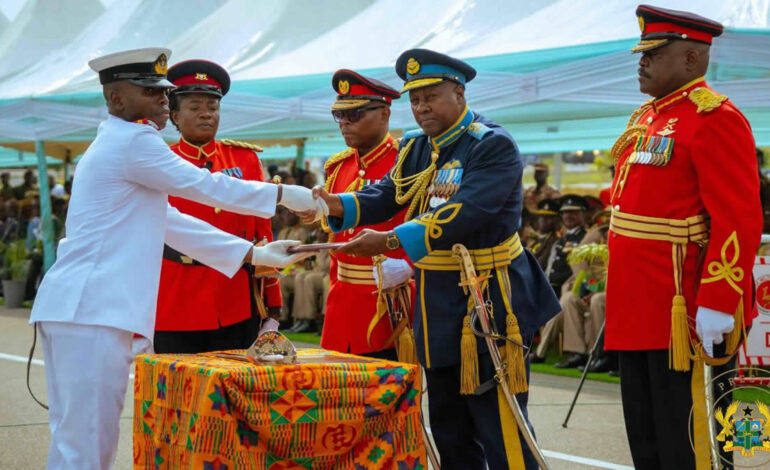
President John Dramani Mahama on Friday reaffirmed his administration’s commitment to strengthening the operational readiness of the Ghana Armed Forces to confront emerging security threats, particularly violent extremism and transnational crime spilling from the Sahel region.
He said the evolving security environment in West Africa, especially along Ghana’s northern borders, required sustained investment in equipment, personnel, welfare and inter-agency cooperation to preserve national stability.
President Mahama was speaking at the graduation parade of the Ghana Military Academy Regular Career Course 64 and Short Service Commission/Special Duties Course 62 in Accra.
A total of 256 officer cadets successfully completed months of rigorous military and academic training and were commissioned into the Ghana Armed Forces.
“The security environment in our sub-region remains complicated and volatile, with violent extremism, terrorism and transnational crime posing serious threats,” the President said.
“These realities demand a comprehensive and coordinated national response.”
President Mahama said security was a shared national responsibility and called on citizens, communities, traditional authorities and civil society to work closely with security agencies to safeguard Ghana’s peace.
He assured the graduating cadets that his government had prioritised strengthening the Armed Forces through the acquisition of modern equipment, advanced training programmes and improved welfare conditions to ensure effective responses to terrorism, piracy and cross-border crime.
As part of those efforts, President Mahama announced plans to acquire new helicopters to enhance air mobility and rapid response capabilities, while rotor blades would soon be acquired to return the MH-17 heavy-lift helicopters to active service.
He disclosed that the multi-purpose force complex, earlier promised to the military, had been captured under the government’s “Big Push” programme, which would be delivered soon.
On accommodation, the President said construction had commenced on 2,000 housing units for military personnel, forming part of a broader plan to deliver 10,000 housing units for the Armed Forces over the next five years.
“In addition, over the next three years, approximately 12,000 new personnel will be recruited nationwide, supported by the establishment of forward operating bases in strategic border areas,” he said.
Touching on regional and internal security challenges, President Mahama noted that conflicts in parts of the country, including Bawku and Nkwanta, had disrupted lives and livelihoods.
He said the government had increased security deployments, facilitated mediation among traditional leaders, provided humanitarian assistance and initiated long-term development interventions to address the root causes of the conflicts.
The President highlighted Ghana’s longstanding contribution to global peacekeeping, noting that the country remained one of the leading troop-contributing nations to United Nations missions, with Ghanaian personnel serving in 15 peace support operations worldwide.
He gave the assurance that transparency, fairness and merit would continue to guide the selection of personnel for international deployments.
President Mahama praised the Ghana Armed Forces for their unwavering commitment to constitutional rule and democratic governance at a time when the sub-region was witnessing unconstitutional changes of government.
“Exposure to conflict environments has reinforced the Ghana Armed Forces’ deep respect for constitutional rule and civilian authority,” he said.
Addressing environmental security, the President said his administration had intensified the fight against illegal mining through the establishment of the National Anti-Illegal Mining Operations Secretariat (NAMOS), declaring rivers and forest reserves security zones and establishing permanent military bases in affected areas.
Turning to the graduating cadets, President Mahama charged them to serve with integrity, courage and professionalism, reminding them of the foundation of leadership, which were responsibility, service and sacrifice.
Some cadet students who excelled during the training were honoured.
These included the Sword of Honour, awarded to the Overall Best Officer Cadet of Regular Career Course 64, Senior Under Officer Agyare Peter Selorm, who also won the Chief of the Army Staff’s Award and the Tactics Prize.
The Chief of the Air Staff Award (Eagle award) went to Air Force Cadet Tackie-Otoo Nii Ohene, Naval Cadet Officer Abayateye Alex Kojo received the Chief of Naval Staff Award (Sextant Award), and Adams Saeed Ahmed received the Chief of the Defence Staff Award.
Also was the Academic Cane, which went to Cadet Officer Banachiga Maximus -Cliford, and the Military Cane awarded to Officer Cadet Abayateye Alex Kojo.
Source: GNA
Related Posts