From the classroom to the pavement: The quiet struggle of girls on Ghana’s streets
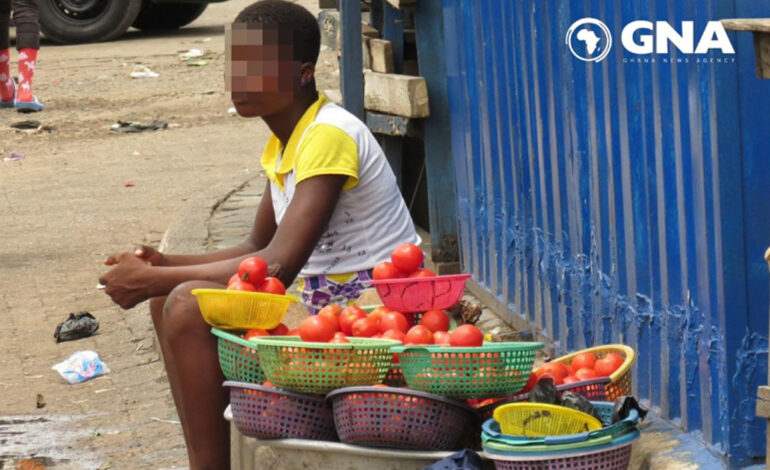
At Accra bustling Tema Station, a steady stream of cars, lorries and tro-tros flows past a young woman seated on the pavement beside plastic bowls filled with deep-red tomatoes.
The midday sun beats down, heating the asphalt and casting long shadows around vendors and head potters scattered along the road.
This is Azumah (not her real name), 19, from Zuarungu in the Upper East Region, attempting to earn enough in a day to survive.
On this particular day, the work, long hours in the glaring sun, had not yielded profit. Some of her tomatoes got damaged before sale, forcing her to absorb the loss, her brow furrowed in quiet worry about how she would recoup her expenses.
Around her, drivers and pedestrians have become accustomed to such scenes. But behind the everyday rhythm lies a story of loss, resilience and survival that remains largely unseen.
A life forced onto the pavement
Azumah’s mother died when she was still in school, and without a father in her life, she was left to fend for herself and younger siblings.
With no one to financially support her education, she dropped out and eventually journeyed south to Accra, joining thousands of other young girls from northern Ghana in search of means to survive.
“I came here because there was no opportunity back home. If I can earn enough, my sister can stay in school,” she says softly, arranging her unsold tomatoes.
Nearby, Patience 18, originally from Walewale in the NorthEast Region, sits beside her own array of produce and problems.
She, too, came south after economic hardship forced her out of school. For both girls, selling vegetables on the roadside pavement is not a choice, it is what survival looks like.
A national pattern, a regional reality
Their experience aligns with broader national patterns.
According to the Ghana Statistical Service (GSS), some regions in northern Ghana show poverty rates above 40 per cent, significantly higher than the national average.
The Upper East, Upper West and Savannah regions consistently rank among the most deprived, with limited access to quality secondary education and formal employment opportunities.
A World Bank report on Ghana’s development notes that rural households, particularly in the north, are more likely to experience persistent poverty, leading many youth, especially girls to migrate to cities or border towns in search of income-earning opportunities.
Many of these ventures land them in precarious, informal work with little regulation or safety nets.
Meanwhile, the Ministry of Education’s data reveals that while primary school enrolment is high, completion rates among girls significantly drop from junior high to senior high school, a trend tied to early pregnancy, withdrawal due to household economic pressures, and school costs that families cannot bear.
Child and youth labour in Ghana
While not all girls at places like Tema Station are technically classified as child labourers, the International Labour Organisation (ILO) estimates that about 21 per cent of Ghana’s children, and a significant portion of youth, engage in child or youth labour, particularly in informal trading, head-carrying (locally known as kayayei), and market vending.
Girls are disproportionately represented in these labour categories due to entrenched gendered expectations around income generation and household contribution.
In Ghana’s urban transport hubs, the ILO has documented numerous cases of female street vendors who work early until late into the night, endure extreme weather conditions, and go for hours without proper hydration, all to secure daily earnings that rarely exceed a handful of cedis.
Invisible burdens, visible hustle
The photographs of Azumah and Patience capture more than just young women selling tomatoes. They reflect layered realities: girls navigating adulthood before they are emotionally or economically equipped; women whose childhood ended prematurely; and youth carrying responsibility that would overwhelm many adults.
In one striking image, Azumah sits among baskets of ripe tomatoes, her shoulders slightly slumped, eyes scanning the crowd.
She wears a simple T-shirt and shorts, feet bare on the concrete pavement, her posture, one of endurance, not leisure.
There are no customers at that moment, but there is expectation in her gaze – a silent measure of time ticking by and money slipping away but she believes in hope.
Nearby, traders carve out their own corners of space: plastic bowls arranged in neat circles, bags of goods rested against metal poles, shoes off feet weary from standing.
Taxis and buses line the edge of the road, their blaring horns underscoring the contrast between economic mobility and the stall’s static existence.
Risks beyond the pavement
For girls living and working on the streets, dangers extend far beyond long hours and sun exposure.
Child protection advocates warn that girls with limited shelter or family support are at heightened risk of exploitation, abuse, and trafficking.
Reports from Ghana’s Department of Social Welfare indicate that many street-connected girls face sexual harassment from men who offer temporary shelter or money, often in exchange for sexual favours.
Without stable accommodation, some girls sleep in markets or beside roadside stalls, vulnerable to theft, violence, and abuse.
About 21 per cent of Ghanaian children aged 5-17 are trapped in child labour, and 14 per cent are engaged in hazardous work, including street vending and other informal activities that expose them to risks such as exploitation and abuse.
While there are no comprehensive national figures on the number of children living and working on the streets, research on street-connected children in Accra shows that many end up on the streets due to inadequate family support, abuse, and family breakdown.
This is evident of the vulnerability of children who fend for themselves without protective supervision.
Non-governmental organisations such as Challenging Heights estimate that over 24,000 children fall victim to the worst forms of child labour in Ghana annually, which includes forced work and exploitation that can drive girls into unsafe environments.
Calls for structural change
Civil society organisations continue to advocate for targeted policy interventions: expanded access to secondary and tertiary scholarships for girls from deprived regions; support for rural livelihoods that reduce pressure to migrate; safe shelters in urban areas for young female traders; and enforcement of child protection laws that safeguard street-connected youth.
While programmes like the Free Senior High School (FSHS) and social protection schemes such as the Livelihood Empowerment Against Poverty (LEAP) initiative have widened access to education and reduced extreme poverty, gaps remain, particularly for girls who exit school early and are left without guidance, provision and protection.
Yet, they persist
As the day drifts toward evening, Azumah begins to pack her remaining goods. The sun begins its slow descent, and the pavement cools.
“Tomorrow, I will come again. If I don’t work here, I won’t eat,” she says.
For Patience and many others, the routine is the same: wake before dawn, prepare goods, find a selling spot, endure the competition and sun, and hope that at day’s end, they would have earned enough to send home and secured a place to sleep.
They remain, not as symbols of poverty, but embodiments of tenacity shaped by circumstances.
These photographs from Tema Station do more than document individuals with bouquets of tomatoes.
They unravel stories of families left behind, education interrupted, future plans aborted, and youth confronted with the urgent need to survive.
In the faces of these girls, one sees a generation caught between hope, obligation, and economic precarity, a generation that demands more than pity, but robust, sustained action.
They are not counted as part of the macro economic gains and Ghana’s growth. Their lives do not really matter to the occupants of the ever rising high rise buildings forming Accra’s new glittering skyline.
Azumah was last seen walking towards the congested road. Her silhouette against the fading sun is both fragile and fierce, a testament to the everyday reality of young girls surviving at the margins of Ghana’s economy; one tomato at a time.
By James Amoh Junior
Source: GNA
Related Posts