Ablakwa appeals to British High Commissioner to exempt Ghanaians from IELTS requirement
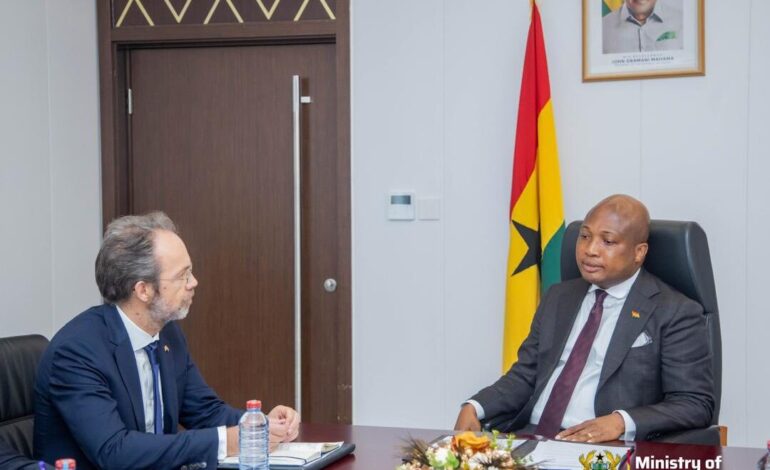
Foreign Affairs Minister, Samuel Okudzeto Ablakwa, has appealed to the British High Commissioner, to Ghana, Christian Rogg to consider exempting Ghanaian students from taking the International English Language Testing System (IELTS) examination as a requirement for admission into universities in the United Kingdom.
The appeal is grounded in the argument that English has been the official medium of instruction in Ghana’s education system from the basic level through to tertiary education, making the compulsory language proficiency test a duplication of assessment that places additional financial and administrative burdens on Ghanaian students seeking higher education opportunities in the United Kingdom
“I made a special appeal for Ghana to be exempted from the International English Language Testing System (IELTS) and the required fees payable by Ghanaian students and professionals since English has long been the Medium of Instruction in Ghana.” he wrote on his Facebook page
Ghana, a former British colony and member of the Commonwealth, conducts all formal instruction, examinations, and official academic assessments in English, including the West African Senior School Certificate Examination (WASSCE) and university-level programmes.
According to the Minister, requiring Ghanaian students, who have spent over a decade receiving formal education in English, to sit an additional language test places avoidable costs on prospective students seeking higher education opportunities in the UK. He noted that the IELTS examination, which can cost several thousand Ghana cedis, often delays applications and excludes otherwise qualified students.
The IELTS test is currently a standard requirement set by UK universities and immigration authorities as part of admissions and visa processes for international students, including those from English-speaking countries. UK institutions argue that the test provides a uniform and standardised measure of English language proficiency across applicants from diverse educational systems worldwide.
However, Ablakwa contends that Ghana’s long-standing use of English as the language of instruction, coupled with internationally recognised academic qualifications, should qualify Ghanaian students for exemptions or alternative assessment mechanisms, as is the case in some jurisdictions. He urged the UK authorities to adopt a more context-sensitive approach that recognises Ghana’s educational framework and Commonwealth ties.
The call adds to a broader and ongoing debate across several English-speaking African countries, where stakeholders have questioned the continued relevance of IELTS requirements for students whose entire academic training has been conducted in English. Any change, however, would require policy adjustments by UK universities and immigration authorities, which currently rely on IELTS as a benchmark for academic preparedness and visa compliance.
Data from available IELTS test-taker performance reports indicate that Ghanaian candidates have consistently recorded strong average scores in recent years, reinforcing arguments about the country’s high level of English proficiency.
Aggregate performance data show that Ghana’s overall mean IELTS band score has remained in the mid-6 range between 2022 and 2024, aligning with the minimum language requirements of many UK universities. In the most recent reporting period covering 2024–2025, global IELTS data further indicate marginal gender differences, with female candidates recording an average overall band score of about 6.4 compared to 6.3 for males.
Although IELTS partners do not publicly disaggregate gender-specific scores by country, the overall performance trend suggests that Ghanaian test-takers demonstrate sufficient English competence, strengthening calls for exemptions based on the country’s long-standing use of English as the medium of instruction.
Source: Diplomatic Times
Related Posts