
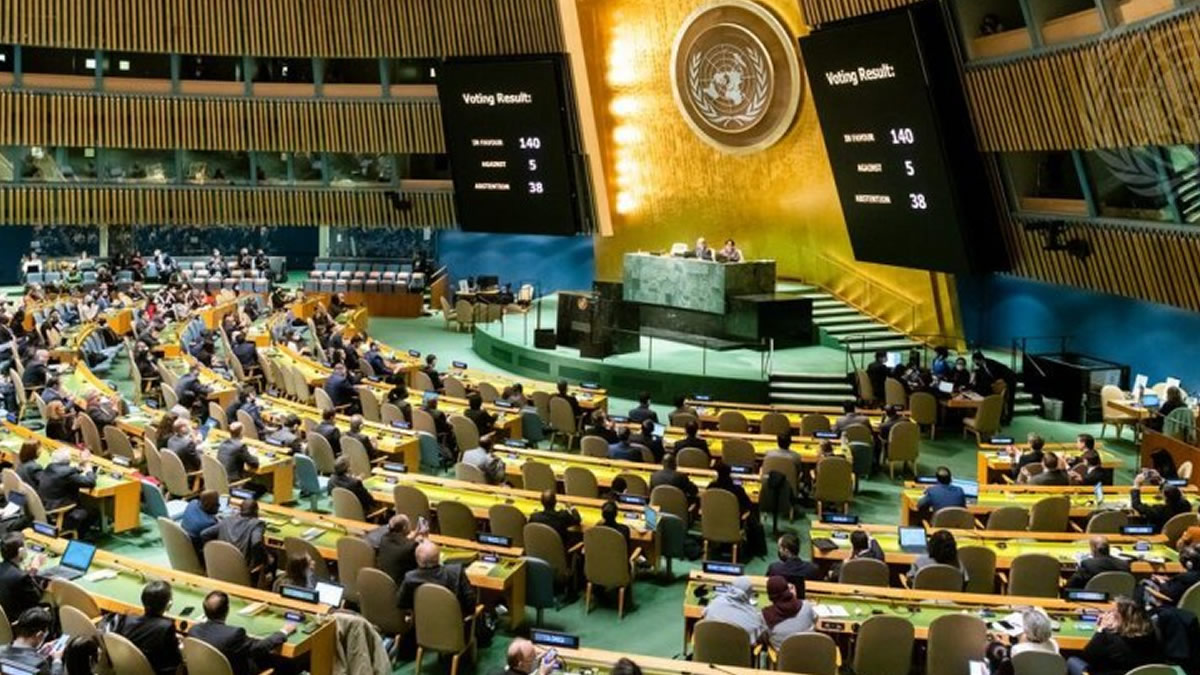
Ghana has secured a second consecutive three-year term on the United Nations Human Rights Council (UNHRC), receiving 173 votes in an election at the UN General Assembly on Tuesday, October 13, as its record during its first term comes under renewed scrutiny.
Ghana will serve on the 47-member Council from January 1, 2027, to December 31, 2029, extending its membership beyond its current 2024–2026 term.
The country was elected alongside Zambia, which topped the African regional group with 177 votes, Nigeria with 172 and Burundi with 160. The four countries filled the seats allocated to Africa, with each candidate receiving more votes than the required threshold for election.
Across the other regional groups, Kuwait and Nepal each secured 173 votes, followed by Jordan with 171 and Japan with 166 in the Asia-Pacific group.
Brazil and the Dominican Republic received 170 votes each, while Uruguay secured 165 in the Latin American and Caribbean group. In the Western European and Others group, Ireland received 165 votes and Germany 163. Moldova secured 168 votes and Ukraine 162 in the Eastern European group. All results were based on 181 valid ballots
Foreign Affairs Minister Samuel Okudzeto Ablakwa welcomed Ghana’s re-election, describing it as another achievement for the country’s diplomacy.
“Team Ghana keeps winning! We are grateful to UN Member States for impressively electing Ghana to the United Nations Human Rights Council (2027-2029) for the second consecutive time. For God and Country,” he wrote in a post on Wednesday, October 14.
One of Ghana’s notable contributions has been its role in advancing resolutions addressing racism and racial discrimination, alongside efforts to strengthen human rights protections in countries facing institutional and capacity challenges.
At the Council’s 60th session in October 2025, Ghana sponsored, on behalf of the Group of African States, a resolution titled “From rhetoric to reality: a global call for concrete action against racism, racial discrimination, xenophobia and related intolerance”.
The resolution, adopted without a vote on October 7, called for more concrete action against racism and related forms of intolerance. It placed Ghana at the centre of a collective African effort to press for stronger implementation of international commitments on racial equality.
Ghana also sponsored resolutions on behalf of the African Group addressing technical assistance and capacity-building in the field of human rights in Mali and South Sudan during the Council’s 58th session in March 2025.
At the 60th session later that year, Ghana similarly sponsored resolutions on behalf of the African Group concerning technical assistance and capacity-building to improve the human rights situation in Libya. These initiatives sought to maintain international engagement with countries requiring support to strengthen human rights protections and institutions.
Such resolutions are an important part of the Council’s work, which includes promoting international cooperation, responding to human rights concerns and supporting countries in strengthening their institutions. Their adoption, however, does not by itself establish that conditions on the ground have improved. Their impact depends on implementation by governments and sustained international support.
The Council, established in 2006, is the UN’s principal intergovernmental body responsible for promoting and protecting human rights worldwide. Its mechanisms include the Universal Periodic Review, which examines the human rights records of all UN member states, as well as special procedures and investigative missions that scrutinise alleged violations.
Ghana’s second term will provide another opportunity to influence resolutions, contribute to debates and work with other states on issues ranging from racial discrimination and accountability to the protection of fundamental freedoms.
However, the election has also attracted criticism over the absence of competition. All five regional groups presented exactly as many candidates as there were available seats, meaning the General Assembly had no competing candidates to choose from in the election.
Human Rights Watch criticised the process, arguing that competitive elections would give UN member states a meaningful opportunity to reject candidates whose human rights records fall short of the standards expected of Council members.
For Ghana, the new mandate brings both diplomatic opportunity and responsibility. Its record of sponsoring resolutions on racism and human rights capacity-building provides concrete examples of its work during the first term. The challenge over the next three years will be to sustain that engagement, demonstrate the practical value of its initiatives and uphold human rights principles consistently in international forums and at home.
Source: Diplomatic Times
Related Posts